
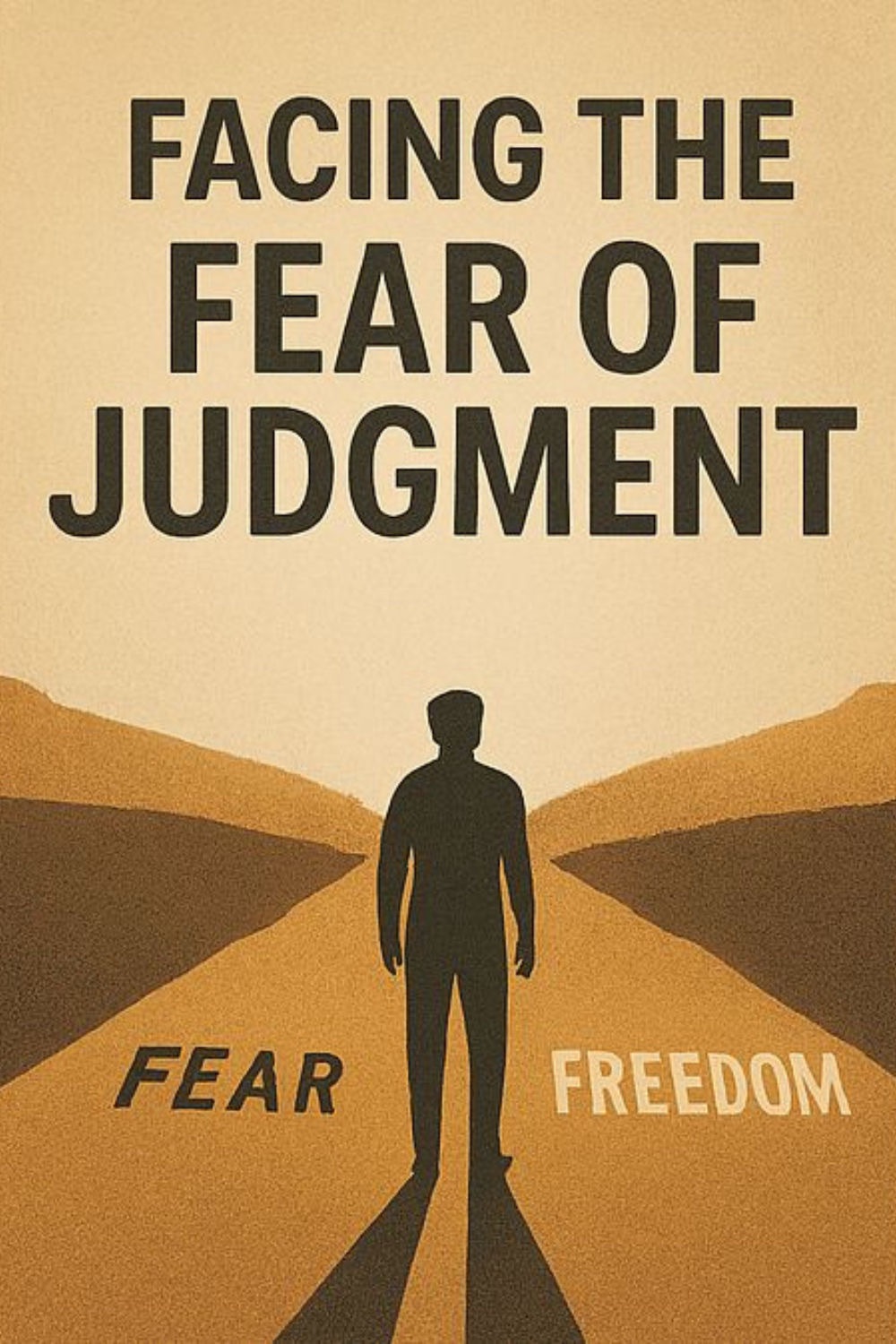
Introduction: The Invisible Prison We All Live In
One of the most powerful forces controlling human behavior is not failure, rejection, or even pain — it is fear of judgment.
We hesitate to speak.
We overthink our actions.
We suppress our dreams.
We edit our personalities.
Not because we don’t know what we want —
but because we are afraid of what people will think.
Fear of judgment silently shapes our decisions, relationships, careers, creativity, and even self-worth. It keeps us stuck in safe zones, trapped in comparison, and disconnected from our true selves.
This blog is not about becoming fearless overnight.
It is about understanding judgment deeply, dissolving its power, and reclaiming your mental and emotional freedom — step by step.
Chapter 1: Understanding the Root of Fear of Judgment
Fear of judgment is not random. It has a psychological, emotional, and social origin.
1. Evolutionary Conditioning
Human beings evolved in tribes. Survival depended on acceptance.
Rejection meant danger.
Your brain still operates on this ancient wiring:
“If they judge me, I may be excluded.”
Even though modern judgment rarely threatens survival, the brain reacts as if it does.
2. Childhood Conditioning
Most fear of judgment begins early:
Being scolded publicly Being compared to others Being praised only for achievements Being told “log kya kahenge?”
Slowly, your self-worth becomes externalized.
3. Society and Social Media
We live in a culture obsessed with:
Appearances Validation Perfection Likes and approval
This constant exposure reinforces the belief:
“My value depends on how I am perceived.”
Chapter 2: The Two Types of Judgment That Control You
1. External Judgment (From Others)
Opinions Criticism Mockery Expectations
2. Internal Judgment (From Yourself)
This is more dangerous.
Your inner voice says:
“I’ll look stupid.” “I’m not good enough.” “They’ll laugh.” “I shouldn’t try.”
Most fear of judgment is self-judgment projected onto others.
Chapter 3: Why Judgment Hurts So Much
Judgment attacks three core human needs:
1. Belonging
You want to be accepted.
2. Identity
Judgment questions who you are.
3. Worth
Judgment makes you feel less-than.
The pain doesn’t come from words —
it comes from meaning you attach to them.
Chapter 4: The Truth About People’s Opinions
Here’s a liberating truth:
People are not thinking about you as much as you think they are.
Most people are:
Busy judging themselves Lost in their own fears Focused on their own problems
Judgment is usually:
A reflection of their insecurity Their conditioning Their unmet desires
It has very little to do with you.
Chapter 5: Why You Can’t Please Everyone (And Shouldn’t Try)
Trying to avoid judgment leads to:
People-pleasing Suppressed emotions Burnout Loss of identity
No matter what you do:
Some will like you Some will misunderstand you Some will judge you
Trying to control opinions is mental slavery.
Freedom begins when you accept:
“I am allowed to be misunderstood.”
Chapter 6: How Fear of Judgment Destroys Your Potential
Fear of judgment:
Kills creativity Blocks self-expression Delays growth Prevents authenticity
Most regrets are not about failure —
they are about not trying because of fear.
You don’t lose confidence by failing.
You lose confidence by betraying yourself.
Chapter 7: Awareness — The First Step to Freedom
Ask yourself:
When did I start caring this much? Whose approval am I seeking? What am I afraid of losing?
Write it down.
Fear dissolves when brought into conscious awareness.
Chapter 8: Reframing Judgment — A Mental Shift
Instead of seeing judgment as:
❌ A threat
See it as:
✅ Information
✅ Feedback
✅ Noise
✅ Projection
Judgment does not define you unless you agree with it.
Chapter 9: Build an Inner Validation System
Stop outsourcing your worth.
Practice:
Self-acknowledgment Self-respect Self-trust
Ask daily:
“Did I act in alignment with my values today?”
If yes — that’s enough.
Chapter 10: Detach From Identity Labels
You are not:
Your mistakes Your achievements Your roles Others’ opinions
You are awareness experiencing life.
When identity loosens, judgment loses grip.
Chapter 11: The Power of Self-Acceptance
Acceptance does not mean stagnation.
It means peace while evolving.
Say:
“I am enough as I am — and I am growing.”
This removes the urgency to impress.
Chapter 12: Practical Exercises to Remove Fear of Judgment
1. Exposure Practice
Do small things that trigger mild judgment:
Speak your opinion Dress differently Share your thoughts
Your nervous system learns:
“I survived.”
2. Worst-Case Visualization
Ask:
What’s the worst that can happen? Can I handle it?
Usually — yes.
3. Rejection Therapy
Intentionally allow rejection.
It builds emotional immunity.
Chapter 13: Stop Over-Explaining Yourself
Over-explaining comes from fear.
You don’t owe:
Justification Permission Validation
Silence is powerful.
Chapter 14: Mindfulness and Detachment
Meditation helps you observe thoughts instead of obeying them.
Fear of judgment is just:
A thought A sensation A temporary story
You are not the thought.
Chapter 15: Healing the Inner Child
Often, fear of judgment is a wounded child seeking approval.
Ask:
“What did I need back then that I still seek now?”
Give it to yourself.
Chapter 16: Spiritual Perspective — The Monk’s Wisdom
From a spiritual lens:
Judgment belongs to the ego Freedom belongs to awareness
A monk walks freely because:
He has nothing to prove.
Live lightly.
Live honestly.
Chapter 17: Let People Think What They Want
This is radical freedom.
You don’t need:
Everyone to agree Everyone to like you Everyone to understand you
Your job is not to manage opinions —
it is to live truthfully.
Chapter 18: Confidence Is Not Loudness
True confidence is:
Calm Grounded Non-reactive
It comes from:
Self-alignment, not approval.
Chapter 19: Replace Fear With Purpose
When your purpose is bigger than judgment,
fear becomes irrelevant.
Ask:
“What matters more — my truth or their opinion?”
Chapter 20: Daily Affirmations to Release Fear of Judgment
I release the need for external validation. I allow myself to be seen and heard. I am safe being myself. Opinions do not define me. I choose authenticity over approval.
Conclusion: The Freedom on the Other Side of Judgment
On the other side of fear of judgment lies:
Authenticity Creativity Confidence Inner peace
People will judge.
They always have.
They always will.
But one day, you realize:
The only judgment that ever mattered was your own.
And when you stop judging yourself —
the world loses its power over you.
Final Thought (Modern Monk Insight)
You were not born to perform.
You were born to experience, express, and evolve.
Let them judge.
You live.

Akshay Kapoor is a writer and digital creator focused on mental wellness, mindfulness, and personal growth. Through his platform Think Like a Modern Monk, he shares practical insights on managing stress, building mental resilience, and creating a balanced life in today’s fast-paced world.
His work explores topics such as psychology, emotional well-being, productivity, and the science of a healthy mind. Akshay aims to simplify complex ideas about mental health and self-development into actionable strategies that readers can apply in their daily lives.
When he’s not writing, he enjoys studying books on psychology, spirituality, and human behavior, and creating content that helps people cultivate inner peace while pursuing their ambitions.