Introduction: Why So Many of Us Feel Lost (Even When Life Looks “Fine”)
Have you ever asked yourself, “Is this really it?”
You may have a job, responsibilities, routines, and people around you—yet something inside feels empty, restless, or unfulfilled. You wake up, get through the day, sleep, and repeat. Life is moving, but you feel disconnected from meaning.
This inner questioning isn’t a weakness.
It’s a signal.
In Japan, this feeling has a name—and an answer.
It’s called Ikigai.
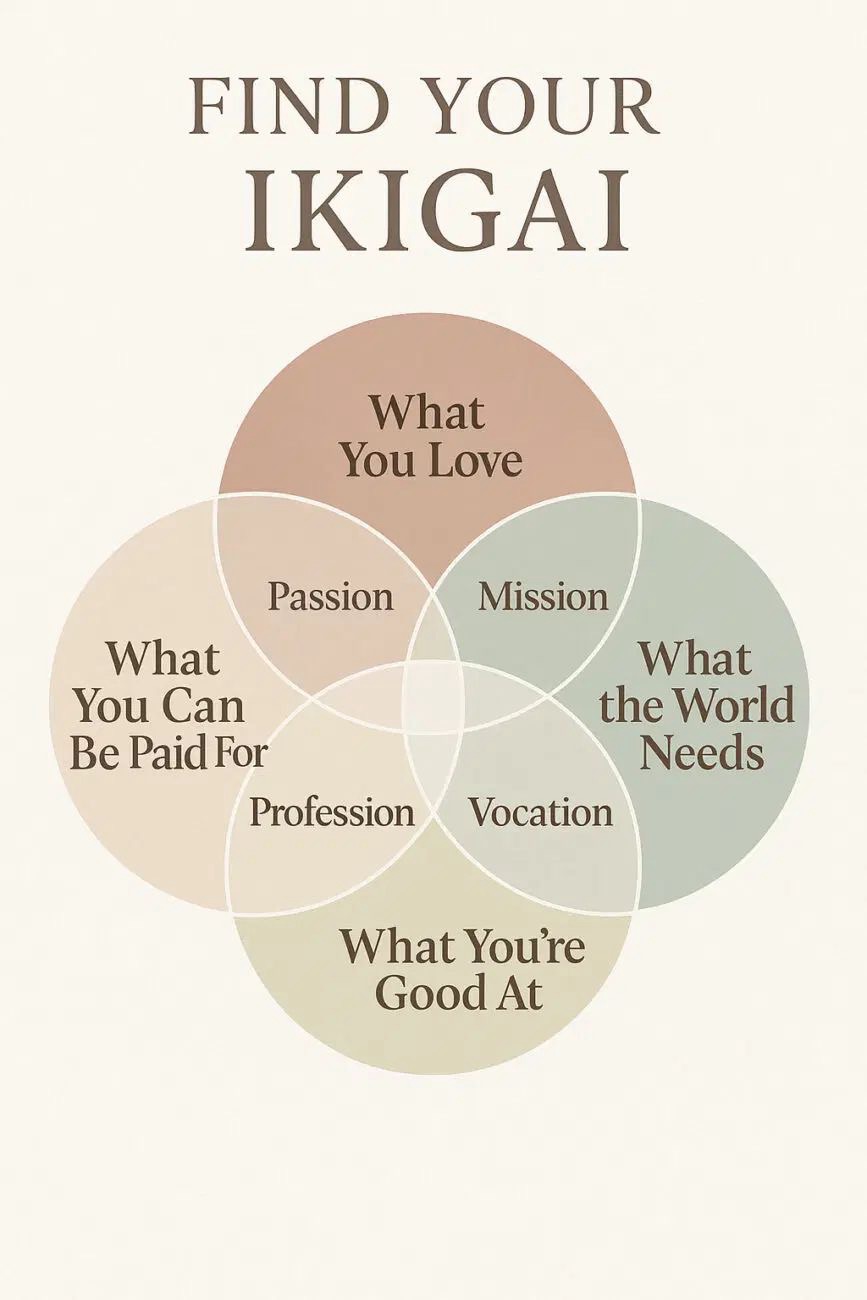
Ikigai roughly translates to “a reason for being” or “a reason to wake up in the morning.” It’s the sweet spot where passion, mission, profession, and vocation meet—but more importantly, it’s about living a life that feels deeply aligned and worthwhile.
In this blog, you’ll learn:
What Ikigai truly means (beyond Instagram diagrams) Why finding Ikigai improves mental health The myths around purpose A step-by-step process to discover your Ikigai Real-life examples Practical exercises to help you start today
This isn’t about overnight transformation.
It’s about slow clarity and sustainable fulfillment.
Chapter 1: The True Meaning of Ikigai (And What It Is NOT)
The Western Misinterpretation of Ikigai
Most people know Ikigai through a popular Venn diagram:
What you love What you’re good at What the world needs What you can be paid for
While helpful, this diagram oversimplifies Ikigai.
In Japan, Ikigai is not always:
A career A passion project A grand life mission
For many Japanese elders in Okinawa (where people live exceptionally long lives), Ikigai is:
Tending a garden Teaching grandchildren Morning walks Being useful to others
Ikigai is not about achievement.
It’s about meaning.
Ikigai Is Personal, Quiet, and Evolving
Your Ikigai:
Doesn’t need validation Can change over time Doesn’t have to impress anyone
Some days, your Ikigai may be your work.
Other days, it may be your healing, growth, or service.
Chapter 2: Why Finding Your Ikigai Is Crucial for Mental Health
Ikigai and Psychological Well-Being
Research shows that people with a strong sense of purpose:
Experience lower stress and anxiety Have better emotional resilience Recover faster from setbacks Live longer and healthier lives
When you lack Ikigai, you may experience:
Chronic dissatisfaction Burnout Anxiety without clear cause Feeling “stuck” or directionless
Purpose acts like an internal compass.
Even when life is hard, purpose gives pain a direction.
Ikigai vs Hustle Culture
Modern culture glorifies:
Constant productivity External success Comparison Speed
Ikigai teaches:
Presence Contribution Balance Inner fulfillment
Finding Ikigai is not about doing more.
It’s about doing what matters.
Chapter 3: Common Myths About Finding Your Purpose
Myth 1: “I Must Have One Big Purpose”
Truth:
You can have many Ikigais across life phases.
At 20, your Ikigai may be learning.
At 30, it may be building stability.
At 40, it may be guiding others.
Purpose evolves as you do.
Myth 2: “Others Have It Figured Out—I Don’t”
Most people are:
Experimenting Adapting Pretending they’re certain
Clarity comes from action, not overthinking.
Myth 3: “Ikigai Means Quitting My Job”
Not at all.
You don’t need to:
Leave your career Take huge risks Start something dramatic
Often, Ikigai starts by changing how you relate to what you already do.
Chapter 4: The Four Pillars of Ikigai (Explained Deeply)
Let’s break down each element—not intellectually, but emotionally.
1. What You Love (Your Joy & Curiosity)
Ask yourself:
What activities make me lose track of time? What do I enjoy even when I’m tired? What topics do I naturally gravitate toward?
This doesn’t have to be extraordinary.
Love can be:
Writing Teaching Listening Creating Solving problems Helping others feel calm
👉 Exercise:
Write 10 moments in your life when you felt genuinely alive.
2. What You’re Good At (Your Natural Strengths)
This includes:
Skills you’ve developed Talents others appreciate in you Abilities that feel “natural”
Often, we overlook strengths because they feel easy.
Ask:
What do people ask me for help with? What comes naturally to me? What challenges do I handle well?
👉 Exercise:
Ask 5 people: “What do you think I’m naturally good at?”
3. What the World Needs (Your Contribution)
This is not about saving the world.
It’s about making someone’s life better.
The world needs:
Emotional support Clarity Education Creativity Healing Leadership Kindness
Ask:
Who do I feel drawn to help? What problems bother me deeply? What change do I want to see?
4. What You Can Be Paid For (Sustainability)
Money is not evil—it’s practical.
Ask:
How can my strengths create value? What skills are useful in today’s world? How can I grow economically without losing meaning?
Ikigai balances meaning and livelihood, not one over the other.
Chapter 5: Step-by-Step Process to Find Your Ikigai
Step 1: Slow Down (Clarity Needs Space)
Ikigai cannot be found in constant noise.
Start with:
Digital detox Journaling Silence Mindful walks
You can’t hear your inner voice if life is too loud.
Step 2: Reflect on Your Story
Your pain holds clues.
Ask:
What challenges shaped me? What have I overcome? What lessons did I learn the hard way?
Often, your Ikigai is connected to what you once needed.
Step 3: Experiment Without Pressure
Don’t wait for certainty.
Try:
Writing Teaching Volunteering Content creation Learning new skills
Purpose is discovered through movement, not perfection.
Step 4: Notice What Energizes vs Drains You
Energy is a compass.
After activities, ask:
Do I feel expanded or exhausted? Inspired or empty?
Your Ikigai gives energy—even when it’s challenging.
Step 5: Commit Gently, Not Aggressively
Ikigai grows with consistency, not force.
Small actions daily > big plans rarely executed.
Chapter 6: Real-Life Examples of Ikigai
Example 1: The Corporate Employee
A project manager finds Ikigai not just in tasks, but in:
Organizing chaos Supporting team growth Creating clarity
Same job. New meaning.
Example 2: The Creator
A person starts sharing mental wellness content—not to go viral, but to help others feel less alone.
That act becomes purpose.
Example 3: The Homemaker
Raising emotionally secure children becomes Ikigai—impacting generations.
Ikigai is not about scale.
It’s about depth.
Chapter 7: Ikigai and Long-Term Fulfillment
Finding Ikigai doesn’t mean:
Life becomes easy Problems disappear
It means:
Struggles feel meaningful You bounce back faster You feel aligned, not empty
Ikigai gives you a why strong enough to face any how.
Chapter 8: Daily Practices to Stay Connected to Your Ikigai
Morning intention setting Journaling one meaningful moment Weekly reflection Saying no to misaligned commitments Continuous learning
Purpose fades when ignored—but strengthens when honored.
Conclusion: Your Ikigai Is Already Within You
You don’t need to find your Ikigai.
You need to remember it.
It lives in:
Your curiosity Your pain Your strengths Your desire to matter
Stop asking:
“What should I do with my life?”
Start asking:
“How can I live truthfully today?”
That’s where Ikigai begins 🌿

Akshay Kapoor is a writer and digital creator focused on mental wellness, mindfulness, and personal growth. Through his platform Think Like a Modern Monk, he shares practical insights on managing stress, building mental resilience, and creating a balanced life in today’s fast-paced world.
His work explores topics such as psychology, emotional well-being, productivity, and the science of a healthy mind. Akshay aims to simplify complex ideas about mental health and self-development into actionable strategies that readers can apply in their daily lives.
When he’s not writing, he enjoys studying books on psychology, spirituality, and human behavior, and creating content that helps people cultivate inner peace while pursuing their ambitions.